Overview
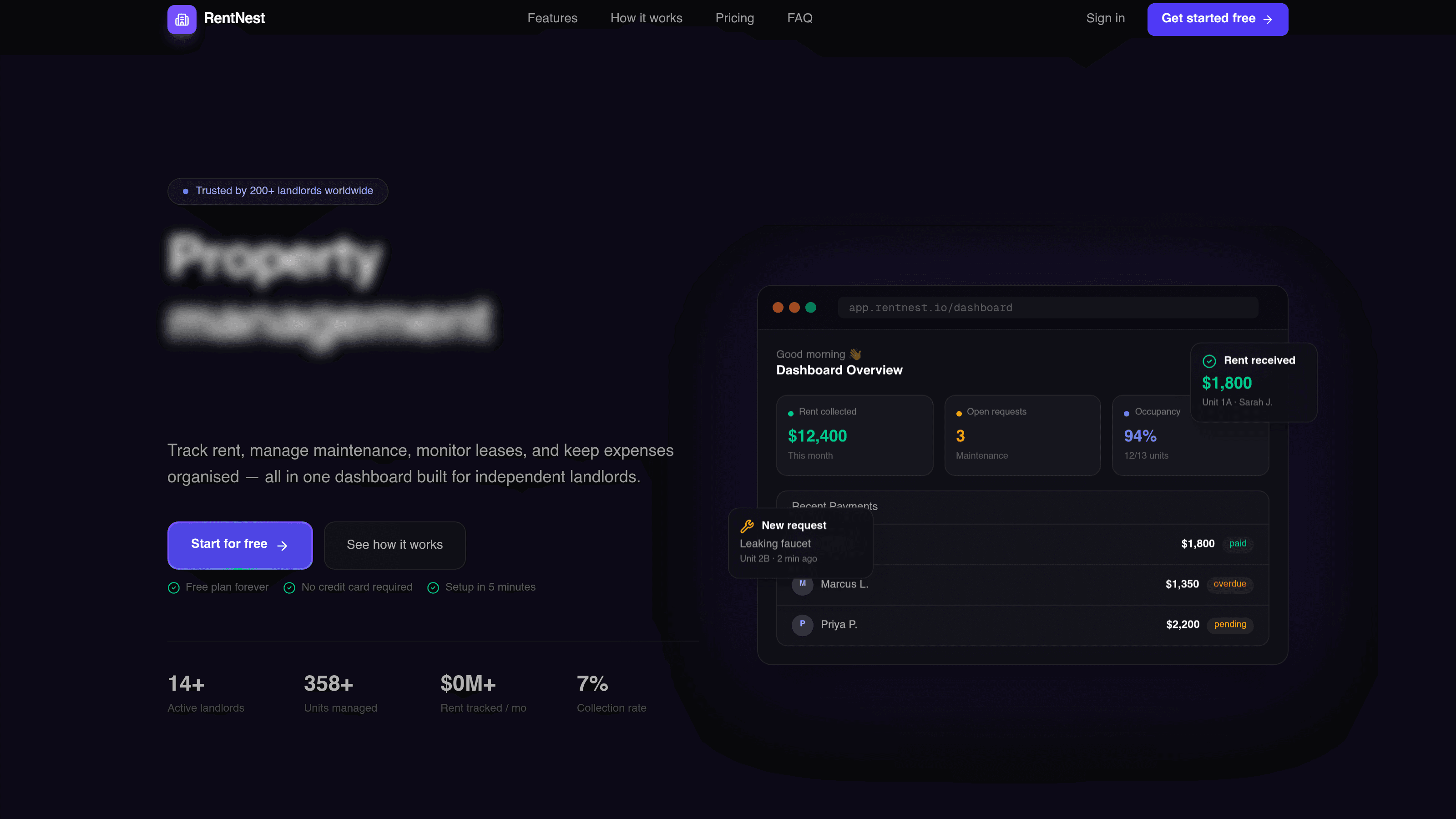
RentNest is a property management SaaS for independent landlords. It handles rent tracking, maintenance requests, lease management, automated reminders, and expense reporting — all from a single dashboard. The differentiation: tenants interact via tokenized links, no account required.
The Problem
Independent landlords managing multiple properties use spreadsheets, WhatsApp, and email chains to track rent, maintenance, and leases. Enterprise tools like AppFolio or Buildium are priced for large portfolios ($250+/mo) and overkill for landlords with 1–10 units.
RentNest targets that gap: a professional property management system at free-to-$59/mo pricing.
Key Features
- Rent tracking — log payments, due dates, auto-mark overdue
- Maintenance portal — tenant submits via private link, no account needed
- Automated reminders — rent due emails via Resend
- Lease management — 60-day expiry alerts, 1-click renewal with pre-filled data
- Expense reports — per-property P&L, CSV export
- Multi-property management — unlimited properties on upper tiers
Architecture: Tokenized Tenant Portals
The no-login tenant portal was the core architectural challenge. Tenants receive a private link (unique token per unit) that gives them read access to their lease, the ability to submit maintenance requests, and payment status — without creating an account.
Implementation:
- Landlord adds tenant → system generates
uuid-based token - Token stored in Supabase with RLS policy tied to
unit_id - Tenant link:
/portal/{token}— no auth required - Supabase RLS verifies the token matches the row-level policy before returning any data
- Maintenance submissions use the same token for attribution
This pattern avoids password reset flows, login friction, and forgotten credentials — the biggest UX failures in property management software.
Stack
| Layer | Technology |
|---|---|
| Frontend | Next.js 15 (App Router), TypeScript, Tailwind |
| Database | Supabase (Postgres + RLS + Auth) |
| Payments | Stripe (subscriptions + Lifetime deal) |
| Resend (transactional reminders) | |
| Deploy | Vercel |
Confirmed: RentNest footer literally reads "Built with Next.js · Supabase · Stripe · Resend"
Pricing Architecture
- Starter — Free (1 property, 3 tenants, 100MB)
- Pro — $29/mo (10 properties, unlimited tenants, Stripe payment links)
- Landlord — $59/mo (unlimited properties, team access, white-label portal)
- Lifetime — $199 one-time (everything in Landlord, no recurring)
The Lifetime deal is a key conversion driver — a one-time payment that converts cost-averse landlords who resist subscriptions.
Tradeoffs & Decisions
Tokenized links over full auth for tenants — Full auth adds friction that kills activation for non-technical users. Tokens are stateless from the tenant's perspective but fully traceable on the server. The risk (token sharing) is acceptable in the landlord-tenant context.
Stripe Lifetime alongside subscriptions — Lifetime deals cannibalize MRR but generate upfront cash flow, attract early adopters, and create word-of-mouth. RentNest treats Lifetime as a launch tool, not a permanent pricing tier.
Resend over SendGrid — Simpler API, better developer experience, lower cost at this volume, and first-party support for React email templates.
What This Proves
RentNest is vertical SaaS proof for the real estate industry: multi-tenant RLS, tokenized auth patterns, Stripe Lifetime deals, and transactional email in a single production system.
If you need a property tech platform, tenant portal, or vertical-specific SaaS with complex billing, this is the architecture we'd apply.