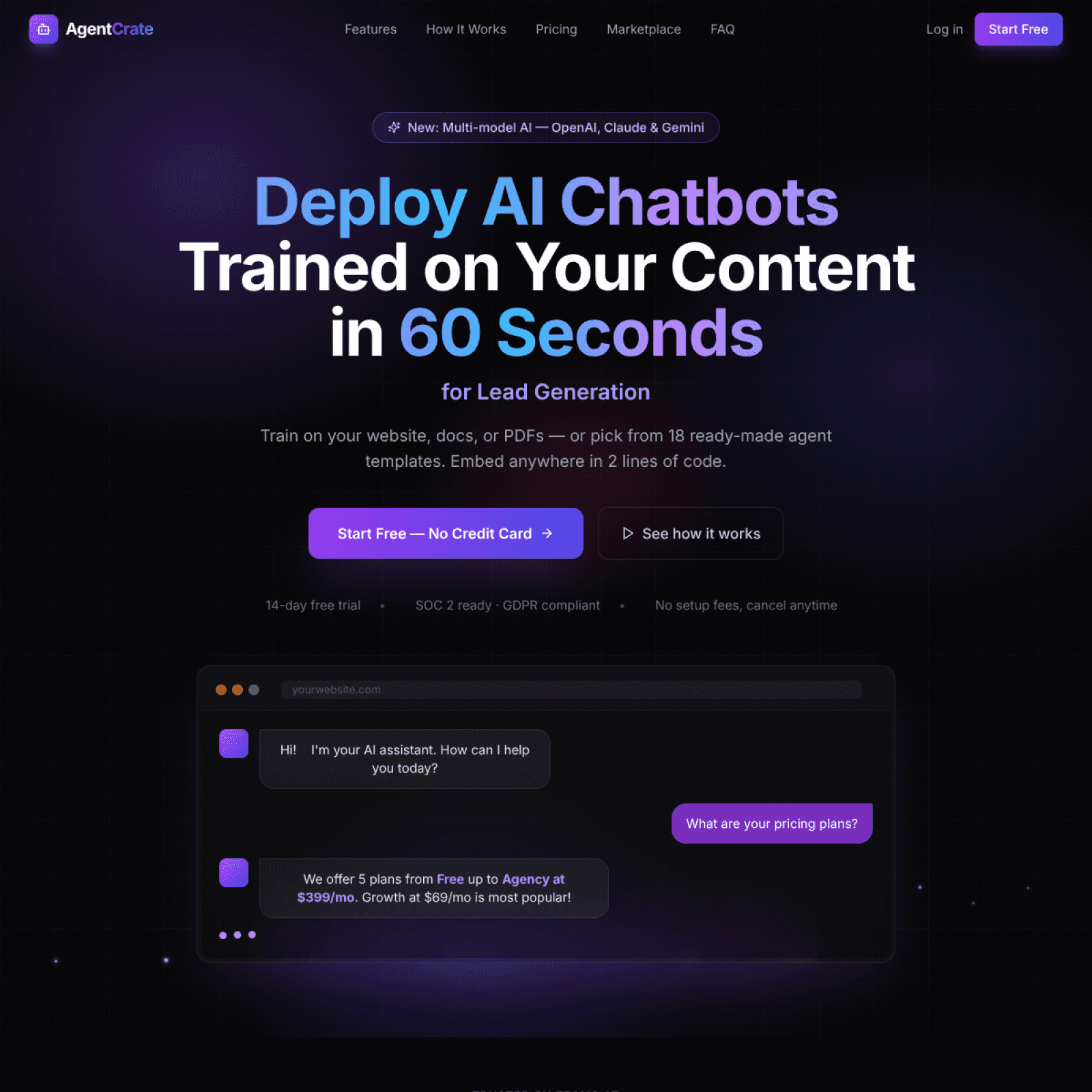
Overview
AgentCrate is a production RAG platform that lets any business deploy an AI chatbot trained on their own content in 60 seconds — no ML expertise required. It ships with multi-model AI routing, a 100+ agent marketplace, a 2-line embed script, and full white-label agency mode.
The Problem
Most AI chatbot tools give you a generic LLM wrapper. Businesses need chatbots that actually know their product, their docs, their pricing. Building that from scratch means managing embeddings, vector databases, chunking strategies, retrieval pipelines, and model switching — weeks of infrastructure before a single customer interaction.
AgentCrate collapses that entire stack into a SaaS product anyone can configure in an afternoon.
Architecture
The core is a RAG pipeline:
- Ingestion — URL scraping, PDF/DOCX/CSV upload, or sitemap crawl
- Chunking — Recursive text splitter with overlap tuning
- Embeddings — OpenAI
text-embedding-3-smallstored in pgvector (Supabase Postgres) - Retrieval — Cosine similarity search, top-K chunks injected into context
- Generation — Multi-model routing: GPT-4o, Claude 3.5 Sonnet, or Gemini 1.5 Pro per chatbot config
- Delivery — Embeddable widget under 20KB via CDN script tag
URL/file → embeddings → pgvector → similarity search → context injection → model response
Key Technical Decisions
pgvector over Pinecone — Supabase already handles auth, RLS, and storage. Keeping vectors in the same Postgres instance eliminates a separate API call on every retrieval and simplifies the security model (RLS policies cover vector rows too).
Multi-model routing per chatbot — Different use cases need different models. A support bot can use GPT-4o-mini for cost. An enterprise sales bot gets Claude 3.5 Sonnet. Routing is per-chatbot config, not per-account.
HMAC-SHA256 webhooks — All outbound events (lead captured, conversation ended) are signed. Downstream integrations can verify authenticity without API key exposure.
2-line embed — The widget JS is under 20KB. It loads async, mounts a shadow DOM chat bubble, and authenticates via data-agent-id. No React, no framework dependency on the host site.
<script src="cdn.agentcrate.io/widget.js" data-agent-id="YOUR_ID" defer></script>
Stack
| Layer | Technology |
|---|---|
| Frontend | Next.js 15, TypeScript, Tailwind, shadcn/ui |
| Database | Supabase (Postgres + RLS) |
| Vectors | pgvector extension |
| AI | OpenAI GPT-4o, Claude 3.5 Sonnet, Gemini 1.5 Pro |
| Embeddings | OpenAI text-embedding-3-small |
| Payments | Stripe (5 tiers + agency) |
| Resend | |
| Deploy | Vercel |
Pricing Architecture
Five tiers designed to capture the full market:
- Free — 1 bot, 500 msg/mo, 5-page URL training (product-led growth entry)
- Starter — $29/mo, 3 bots, URL + file training
- Growth — $69/mo, multi-model AI, webhooks (most popular)
- Scale — $199/mo, API access, 100k messages
- Agency — $399/mo, white-label, client management portal, custom domain
What This Proves
AgentCrate demonstrates we can build production RAG infrastructure — not a wrapper around the OpenAI API, but a full embeddings pipeline, vector retrieval system, multi-model orchestration layer, and embeddable delivery mechanism — all within a multi-tenant SaaS billing architecture.
If your business needs a custom AI agent, internal knowledge bot, or white-label chatbot product, this is the reference implementation.